GRM vs DSCR: The Screening Number and the Lender's Test
GRM vs DSCR compared: why a low gross rent multiplier can still fail a lender's coverage test, and how to work from gross rent down to debt service.
By the GRMCalculator.com team
GRM vs DSCR is the difference between a screening number and a lender’s test: gross rent multiplier is purchase price divided by gross annual rent, and debt service coverage ratio is net operating income divided by annual debt service. GRM decides which listings are worth a second look. DSCR decides whether the loan on one of them gets funded.
The two numbers can disagree about the same property. A GRM that looks normal for your market can sit on a DSCR below 1.0, which means the rent does not cover the payment.
What GRM and DSCR Each Measure
GRM counts rent against price and nothing else. DSCR counts income against debt and ignores price entirely.
| Gross rent multiplier | Debt service coverage ratio | |
|---|---|---|
| Formula | Price / gross annual rent | NOI / annual debt service |
| Inputs needed | Two | Full operating budget plus loan terms |
| Who uses it | Buyer sorting listings | Lender approving the loan |
| Better when | Lower | Higher |
| Leaves out | Expenses, vacancy, financing | Purchase price, equity return |
The debt service coverage ratio is a coverage test borrowed from commercial lending, where it is applied to everything from warehouses to apartment buildings. A DSCR of 1.25 means income is 25% larger than the payments. The standard definition of DSCR puts net operating income on top, though not every lender does.
GRM has no pass or fail line, and neither does the capitalization rate. Both of those rank properties against each other. DSCR is the one a third party uses to say yes or no. If sorting out the first two is what you need, see whether GRM is the same as cap rate.
Why a Low GRM Can Still Fail a DSCR Test
Take the standard example: a $500,000 rental renting for $4,000 a month, or $48,000 a year. That is a GRM of about 10.4.
Now build the income. At 5% vacancy, collected rent is $45,600. At a 36% expense ratio, operating costs are about $16,400, so net operating income is about $29,200.
Finance it with 25% down. The $375,000 loan at 7% over 30 years costs about $2,495 a month, or about $29,900 a year.
DSCR is $29,200 divided by $29,900, which is 0.98. The property does not quite cover its own debt, and no lender floor sits below 1.0 by accident.
The GRM never moved. It is still 10.4, because the price and the rent did not change. Everything that broke the financing happened in the expenses and the loan, and GRM looks at neither.
Two formulas both called DSCR
Commercial lenders use NOI over debt service. Many lenders writing business-purpose loans on single rentals use a simpler version: market rent divided by PITIA, the principal, interest, taxes, insurance and association dues.
Run the same house the second way. Say taxes, insurance and dues account for $9,000 of that $16,400, a share that varies widely by state. PITIA is then about $38,900, and $48,000 of rent divided by that is 1.23.
Same price, same rent, same house: 0.98 on the NOI version and 1.23 on the gross rent version. Ask which formula the lender uses before you assume you pass.
How Interest Rates Move DSCR While GRM Sits Still
Debt service per dollar borrowed is the mortgage constant, the annual payment divided by the loan balance. On a 30-year loan it runs about 6.4% at 5% interest and about 8.8% at 8%.
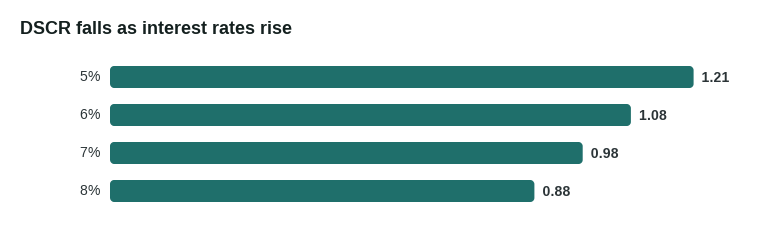
Hold the example and change only the rate.
| Rate | Mortgage constant | Annual debt service on $375,000 | DSCR | GRM |
|---|---|---|---|---|
| 5% | 6.4% | $24,200 | 1.21 | 10.4 |
| 6% | 7.2% | $27,000 | 1.08 | 10.4 |
| 7% | 8.0% | $29,900 | 0.98 | 10.4 |
| 8% | 8.8% | $33,000 | 0.88 | 10.4 |
Three points of rate swing DSCR by about a third while GRM sits still. That is why a rent multiple a seller bought at can be unfinanceable for the next buyer. Weekly 30-year averages come from Freddie Mac’s Primary Mortgage Market Survey.
Down payment does the same work. At 7%, moving from 25% down to 35% down cuts annual debt service to about $25,900 and lifts DSCR to about 1.13. Less borrowed money means less leverage, better coverage, and a smaller return on the cash you tied up.
Working From Gross Rent Down to Debt Service
The two numbers connect through one line of arithmetic:
DSCR = (1 - vacancy) x (1 - expense ratio) / (GRM x LTV x mortgage constant)
Check it against the example. The top is 0.95 x 0.64, or 0.608. The bottom is 10.4 x 0.75 x 0.080, or about 0.62. That gives 0.98, the same answer as the long way round.
The useful direction is backwards. Fix the DSCR you need and solve for the GRM that delivers it.
- Take the lender’s floor, say 1.25.
- Multiply it by your LTV and the mortgage constant: 1.25 x 0.75 x 0.080 = 0.075.
- Divide the top of the formula by that: 0.608 / 0.075 = about 8.1.
So at 7% money, 25% down and 36% expenses, you need a GRM near 8 to clear a 1.25 test. At a 1.20 floor the answer is about 8.5. Those are the real screening limits, and they move the day rates move.
Using Both Numbers Before You Make an Offer
- Screen on GRM first. Ten minutes sorts forty listings and throws out most of them.
- For the survivors, build an honest NOI with reassessed taxes, a real insurance quote, dues, vacancy, maintenance, reserves and management.
- Get a rate quote, then ask the lender two questions: which DSCR formula, and what floor.
- Compute DSCR at the loan you actually expect, not the one you hope for.
- If it clears, check cash on cash return. A property can pass at 1.25 and still pay you very little.
GRM sorts. DSCR gates. Neither tells you whether the deal is worth owning.
Run the numbers on your own deal
Put the price and the monthly rent into the GRM Calculator on the home page to get the multiplier and the implied cap rate in one pass. Then carry the same expense ratio into your lender’s DSCR test and see whether the loan clears at today’s rate.
Frequently asked questions
Is GRM or DSCR more important when buying a rental?
They do different jobs. GRM is faster, so it comes first, when you are deciding which of forty listings deserve an hour of work. DSCR comes second and carries more weight, because a lender can decline the loan over it. A deal with a great GRM and a DSCR of 0.95 is not a deal you can finance.
What DSCR do lenders usually require?
The floor is set by each lender and by the loan program, and quoted minimums on rental property loans commonly run from 1.00 to 1.25. Some programs go below 1.00 with a larger down payment or a higher rate. Ask for the floor and the formula together, since a lender using gross rent gets a higher number than one using net operating income.
Can you convert GRM to DSCR?
Only if you add the missing pieces. GRM gives you rent per dollar of price. To get DSCR you also need a vacancy rate, an expense ratio, the loan-to-value and the mortgage constant that comes from your rate and term. With those five inputs the conversion is arithmetic. Without them, a GRM says nothing about coverage.
Does a higher down payment fix a failing DSCR?
Usually yes, because it shrinks the loan and the payment while rent stays the same. On a $500,000 property at 7%, moving from 25% down to 35% down lifts coverage from about 0.98 to about 1.13. The cost is more cash tied up and a lower return on that cash, so check your cash on cash return before you commit.