Gain to Lease vs Loss to Lease: Pricing the Rent Gap
Gain to lease and loss to lease explained on a real rent roll: how to size the gap unit by unit, what it does to GRM, and how to price the upside.
By the GRMCalculator.com team
Gain to lease is the amount a unit rents for above market rent, and loss to lease is the amount it rents for below market rent. Both are measured on a rent roll, lease by lease, by comparing what a tenant pays today with what the same unit would ask if it came empty this week.

Add those differences up and you have the rent gap. That gap is why one building can look expensive on in-place rent and cheap on market rent, and why two buyers can quote two different multipliers for the same address.
Gain to lease and loss to lease, defined on a rent roll
Loss to lease is unrealized rent on a unit that is already occupied. A tenant signed at $3,600 a year ago, similar units now ask $4,000, and the owner gives up $400 a month until that lease turns.
Gain to lease is the mirror image. The unit rents above today’s market, usually because it was signed at the top of a strong stretch, or because it carries a premium renters no longer pay. Treat gain to lease as rent you will probably lose at renewal, not rent you can bank on.
Most rent rolls net the two into a single line called gain or loss to lease. Sign conventions differ between shops, so read the label before you read the number.
Market rent is an estimate, not a receipt
Everything here depends on the market rent you pick, and that figure is an opinion. Build your rental value estimate from asking rents on comparable units nearby, leases actually signed in the last few months, and your own renewal history. HUD publishes Fair Market Rents for voucher programs, which is useful background but not a stand-in for local asking rents on your unit type.
How to calculate the gap unit by unit
- List every unit with its in-place rent and lease end date.
- Set a market rent for each unit, adjusted for condition, floor and view.
- Subtract in-place rent from market rent for each unit.
- Add the monthly differences and multiply by 12.
- Divide the annual gap by annual market rent to get the gap as a percent.
Here is a four unit version of the standard example on this site: four rentals like the $500,000 one, priced together at $2 million, with market rent of $4,000 a month each.
| Unit | In-place rent | Market rent | Monthly gap |
|---|---|---|---|
| 1 | $4,000 | $4,000 | $0 |
| 2 | $3,800 | $4,000 | $200 loss to lease |
| 3 | $3,600 | $4,000 | $400 loss to lease |
| 4 | $4,200 | $4,000 | $200 gain to lease |
In-place rent is $15,600 a month, or $187,200 a year. Market rent is $16,000 a month, or $192,000 a year. Net loss to lease is $400 a month, $4,800 a year, about 2.5% of market rent.
Do it unit by unit, because unit 4 hides part of unit 3’s problem. That is also the level multifamily GRM work lives at.
What a wide loss to lease does to the multiplier you see
Run the formula both ways. On in-place rent, the GRM is $2,000,000 divided by $187,200, about 10.7. On market rent, it is $2,000,000 divided by $192,000, about 10.4. Same price, two multiples, and the only thing that changed is which rent went in the denominator. The GRM formula does not care where the rent came from.
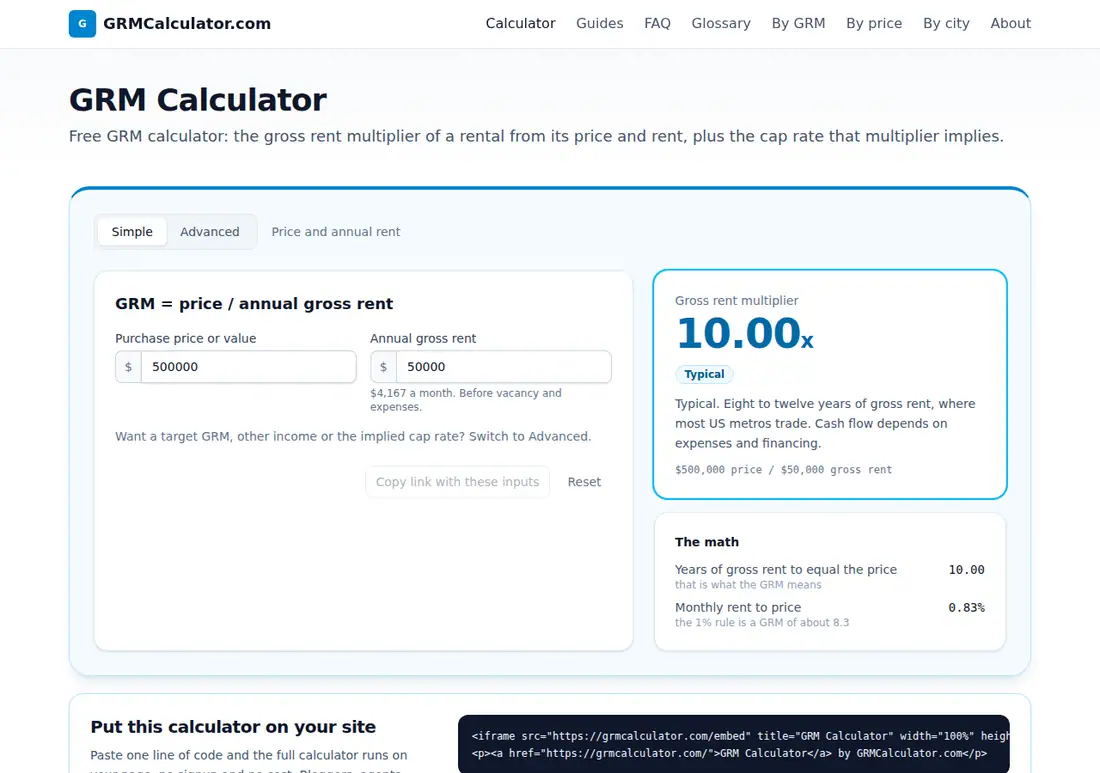
The single property version behaves the same way. A $500,000 rental renting for $4,000 a month collects $48,000 a year, a GRM of about 10.4. With only an annual figure, the simple version gives $500,000 on $50,000 of annual rent, a GRM of 10.
Now widen the gap. Hold the price at $2 million and drop all four leases to $3,600 a month. In-place rent falls to $172,800 a year and the GRM climbs to about 11.6, while the market rent GRM stays at 10.4. More than a point of spread, sitting inside one rent roll.
This is where listings get slippery. A seller with a wide loss to lease will quote market rent as though it were collected, which turns an 11.6 into a 10.4 on paper. That is the difference between projected rent and actual rent, and it is a common reason a deal looks cheaper than it is.
Why the gap exists
Renewals are the usual answer. An owner who raises rent 3% at renewal while the market moves 6% opens a gap every year without doing anything wrong, because turnover costs real money and a paying tenant is worth keeping.
Rent control and local rent caps are the second reason. Where allowed increases are limited by ordinance, long tenancies drift far below market and stay there. The rules vary widely by city and state, so read the local ordinance rather than a rule of thumb, and treat rent regulation as a legal question before a pricing one.
Third is management that never pushes. Nobody shops the comps, so renewals go out at last year’s number plus a token increase.
Fourth is condition. A unit with a 1990s kitchen is at market rent for its condition even if it sits $400 under the renovated unit across the street. That is a renovation budget, not free money.
How long does it take to close the gap?
The gap closes as fast as leases roll. With twelve month leases spread evenly through the year, about a twelfth of the roll turns each month, so a market rate building can capture most of its loss to lease in one to two years, assuming market rent holds and you accept the turnover that comes with repricing.
Rent capped markets are slower. If renewal increases are limited by law, the gap only closes when a unit goes vacant, and that can take many years in buildings with long tenancies.
Market rent can also fall. A gap you planned to capture in year two can shrink on its own, which is why the upside belongs in a sensitivity case and not in the base case.
Pricing the upside without paying the seller for it
Underwrite in-place rent as your base. That is the money the building collects the day you take over.
Price the gap separately, after costs. Each unit you reprice may need paint, appliances, a few weeks of vacancy, and a leasing fee. A $400 monthly gain that costs $3,000 in make-ready and lost rent pays itself back in under a year. A $100 gap on a unit that needs a $15,000 kitchen does not.
Then ask who does the work. The seller wants to be paid today for increases you will spend two years and real cash collecting.
Check your market rent against the neighborhood before you believe your own spreadsheet. If every building nearby shows the same gap, the estimate is probably too high. The metro pages show how far rent levels and multiples vary from one market to the next.
And ask for signed leases, not a column labeled market. Three recent signings at the number you are underwriting are worth more than any pro forma.
Check it with the calculator
Run the rent roll both ways with the free GRM Calculator on the home page. Enter the price with in-place annual rent, write down the multiplier, then enter the same price with market rent. The distance between those two numbers is your loss to lease, priced the way a buyer sees it.

Frequently asked questions
What is gain to lease?
Gain to lease is the amount a unit rents for above current market rent. It shows up on a rent roll when a lease was signed during a strong stretch and the market has since softened. Most buyers treat it as rent they will lose at renewal, so it belongs in a downside case rather than in projected income.
What is loss to lease?
Loss to lease is the gap between what an occupied unit rents for today and what it would ask if it were vacant. A tenant paying $3,600 in a unit that would now list at $4,000 carries $400 a month of loss to lease, or $4,800 a year. The gap closes when the lease turns, not before.
What is gain/loss to lease on a rent roll?
Gain or loss to lease is one netted line that compares in-place rent for every occupied unit with estimated market rent. Units renting above market are gain to lease, units below are loss to lease, and the net figure tells you whether the roll sits above or below market. Sign conventions differ between owners, so read the column label before you read the number.
How does loss to lease affect the gross rent multiplier?
It changes the denominator. Four units bought for $2 million and collecting $187,200 a year carry a GRM of about 10.7, while the same price against $192,000 of market rent gives about 10.4. A building with a wide loss to lease looks expensive on in-place rent and cheap on market rent, so always ask which rent the multiplier used.