Gross Rent Multiplier UK: GRM, Rental Yield and What British Investors Quote
The gross rent multiplier UK buyers need, converted to gross yield and back, with the service charge, ground rent and stamp duty both numbers leave out.
By the GRMCalculator.com team
The gross rent multiplier in the UK is the same calculation used in the United States: purchase price divided by one year of gross rent. British agents and landlords rarely quote it. They quote gross yield, which is that relationship turned over, so a multiplier of 10 is a 10% gross yield and a multiplier of 20 is a 5% one.


This guide handles the conversion in both directions, explains why British multipliers usually land higher than American ones, and names the costs that sit outside both numbers. If the formula itself is new, start with what gross rent multiplier measures.
What gross rent multiplier means in the UK
Gross rent multiplier means price divided by annual gross rent, and the definition does not change at the border. Take the standard example on this site. A $500,000 rental renting for $4,000 a month collects $48,000 a year, so the multiplier is about 10.4. On the simple version, $500,000 against $50,000 of annual rent is a GRM of 10.
The arithmetic is currency neutral. Swap pounds for dollars at the same ratio and the multiplier does not move, because the top and bottom of the fraction are in the same money. That is why the gross rent multiplier travels well as a screening tool even where nobody local uses the term.
Gross yield is the number British landlords quote instead
Gross yield is annual rent divided by price, written as a percentage. A yield of 6% and a multiplier of 16.7 describe the same deal.
Agents, buy to let lenders and property portals all speak in yield. Ask for a multiplier and you will usually get a pause, then a yield figure.
Both numbers ignore the same things. Neither counts void periods, letting fees, insurance, repairs or service charge. Gross yield is not more informative than GRM. It is the local dialect for the same ratio.
How to convert a multiplier into a yield and back
Two lines of arithmetic do all the work:
- Gross yield % = 100 / GRM
- GRM = 100 / gross yield %
The standard example above comes out at 9.6%, because 100 divided by 10.4 is 9.6. The simple version, a GRM of 10, is a flat 10% gross yield.
| Gross rent multiplier | Gross yield |
|---|---|
| 5 | 20% |
| 8 | 12.5% |
| 10 | 10% |
| 12 | 8.3% |
| 15 | 6.7% |
| 20 | 5% |
| 25 | 4% |
| 30 | 3.3% |
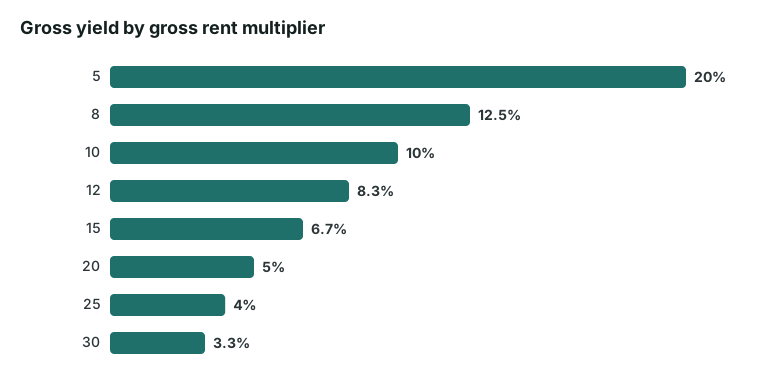
Read the table in either direction. It is the only conversion you need.
Why UK gross rent multipliers run higher than US ones
There are two reasons. One is real and one is a quoting habit.
The real one is price relative to rent. Where house prices have risen faster than rents, the multiplier climbs. A flat quoted at a 4% gross yield carries a multiplier of 25, well over double the 10.4 in the example. Gross yields on British listings tend to sit in the low single digits in and around London and run higher in northern cities, so the matching multipliers cover a wide band. Work the figure out from current asking rents and asking prices in the specific postcode instead of trusting a national average.
The habit is how rent is advertised. UK listings give rent per calendar month, written pcm, so multiply by 12 for the annual figure the multiplier needs. Some lettings, mostly in London, are quoted per week. Multiply a weekly rent by 52, not by 48. Treating four weeks as a month understates annual rent by about 8% and pushes the multiplier up by the same margin.
Service charge, ground rent and stamp duty sit behind a UK multiplier
Most UK flats are leasehold. That brings a service charge, and on older leases a ground rent as well. Both come out of the landlord’s share rather than the tenant’s, and neither one shows up in gross rent. Two flats at the same rent and the same price share a multiplier even when one carries a four figure annual service charge and the other carries none.
The transaction tax is the other gap. The multiplier uses the purchase price, so it leaves out what you pay to buy. Stamp duty land tax applies in England and Northern Ireland, Scotland and Wales run their own property transaction taxes, and additional properties attract a surcharge. Rates and bands change, so read them at source.
Past gross you are into net operating income, which is rent after operating costs. Divide that by price and you get the capitalisation rate, the closest match to the net yield a British investor quotes. The gap between the two measures is set out in whether GRM and cap rate count the same money.
Finance sits outside the multiplier too. UK buy to let lenders run an interest cover test, stressing the rent against a higher assumed mortgage rate, which works much like the debt service coverage ratio American lenders use. A multiplier says nothing about whether a property passes it. Individual landlords also receive a basic rate tax credit for mortgage interest rather than deducting the full cost from rental profit, so two owners holding identical multipliers can keep very different amounts.
Which number to use when comparing property across both markets
Pick one unit and convert everything into it. Four steps:
- Annualise the rent. Monthly times 12, weekly times 52.
- Put every listing in the same measure, multiplier or gross yield, using 100 divided by the other.
- Compare inside one market first. Tax, insurance and service charge differ so much between countries that a multiplier of 12 in Manchester and a 12 in Dallas are not comparable properties.
- Then build net figures. Take out voids, management, repairs, service charge and ground rent, and compare net yield or cap rate.
Gross sorts. Net decides. That order holds in both countries.
Work out your own multiplier
The GRM Calculator on the home page takes a price and a rent and returns the multiplier, and 100 divided by that result is your gross yield. Enter rent monthly or annually, in pounds or dollars. The ratio behaves the same either way.
Frequently asked questions
Is gross rent multiplier used in the UK?
Rarely by name. The formula is in constant use, but British agents, lenders and portals express it as gross yield instead: annual rent as a percentage of price. The two are the same relationship inverted, so a gross rent multiplier of 10 is a 10% gross yield. Investors buying in both countries usually convert everything into one of the two before comparing.
How do you convert gross rent multiplier to gross yield?
Divide 100 by the multiplier. A GRM of 10 is a 10% gross yield, a GRM of 16.7 is about 6%, and a GRM of 25 is 4%. The conversion runs backwards the same way: 100 divided by the yield percentage gives the multiplier. Both figures use gross rent, so neither one accounts for voids, repairs or management.
What is a good gross rent multiplier in the UK?
It depends on the local ratio of prices to rents, so there is no national answer. Multipliers follow asking prices and asking rents, which means expensive southern markets produce high multipliers and lower priced cities produce lower ones. Work out the figure for ten similar listings in the same postcode and use that spread as your benchmark rather than a rule of thumb.
Does gross rent multiplier include service charge and ground rent?
No. Gross rent multiplier uses gross rent, so service charge, ground rent, letting fees, insurance, repairs and void periods all sit outside it. Gross yield leaves them out too. To account for them you need net operating income, which is collected rent minus operating costs, and the cap rate or net yield built from it.