Gross Rent Multiplier on Small Multifamily Buildings
Gross rent multiplier multifamily analysis: how unit mix, vacancy and the jump from four units to commercial financing change what the ratio tells you.
By the GRMCalculator.com team
Gross rent multiplier on multifamily works the same way it works on a house: price divided by annual gross rent. A gross rent multiplier analysis of a duplex, a six-unit or a twenty-unit starts with those two numbers and nothing else. What changes is how much that single rent figure hides. One house has one tenant and one rent. A building has a unit mix, a vacancy pattern, and past four units, a different lending world. There is also no single average GRM in real estate to measure against, because the number moves with the metro, the size of the building and the age of its systems.

Start with the standard example on this site. A $500,000 rental renting for $4,000 a month collects $48,000 a year, so the GRM is about 10.4. If all you have is an annual rent figure, the simple version runs the same way: $500,000 on $50,000 of annual rent is a GRM of 10.
Screening buildings instead of houses
Listings for small buildings nearly always publish a price and a total rent roll. That is everything GRM needs, which is why you can run twenty buildings in a few minutes and sort them. It is a filter, not a verdict.
The difference from screening houses is what sits behind the rent. On a single-family rental, one vacancy drops income to zero. In a duplex, one vacancy drops it by half. In a ten-unit, it costs you a tenth. Spreading that risk is the main reason people buy buildings, and the multiplier cannot see any of it. Two listings at the same GRM can carry very different odds of a bad month.
One caution before you sort: make sure every line uses the same rent basis. Some brokers quote rent under current leases, others quote market rent as if every unit turned over tomorrow. Mix the two and the cheapest-looking building is just the one with the most optimistic broker.
Unit mix and the rent per door problem
Make the $500,000 example a duplex: two units at $2,000 a month, $4,000 total, $48,000 a year, GRM 10.4. Now make it a triplex at the same price with units renting for $1,600, $1,400 and $1,000. Gross rent is still $4,000 a month, and the GRM is still 10.4.
One number, two different properties. The duplex is $250,000 a door with two kitchens and two water heaters. The triplex is about $167,000 a door with three of everything, plus a small unit that will probably turn over more often. Per-door cost runs opposite to per-door price. More doors means more turns, more appliances and more make-readies funded out of the same $48,000.
So read the unit mix next to the multiplier every time. A building of studios and a building of three-bedrooms can land on the same GRM and behave nothing alike.
Units that are not apartments
Check what the units legally are. If they are individually deeded, you are not buying a building, you are buying several units of a condominium with association dues and rules attached. Ground-floor retail makes it a mixed-use development, and commercial rent on a multi-year lease does not belong in the same denominator as month-to-month apartment rent without a note explaining it.
Vacancy and turnover in the gross rent figure
GRM uses gross scheduled rent, meaning rent as if the building stayed full all year. Vacancy never appears in it.
Take the duplex and leave one unit empty for two months. Scheduled rent is still $48,000, so the GRM is still 10.4. Collected rent is $44,000, and $500,000 divided by $44,000 is about 11.4. A single unit sitting empty for two months moved the real multiple a full point.
Turnover compounds that. Every turn costs vacant days plus paint, cleaning and listing time, and cheaper small units turn more often. Ask for twelve to twenty-four months of rent roll history before you trust any gross figure. Watch for short-term rental units too, since seasonal peaks inflate annualized rent in a way annual leases never do.
Where two to four units stop and commercial starts
One to four units counts as residential for most lenders. You get standard mortgage products, an appraisal weighted toward comparable sales, and terms close to what a house buyer sees. At five units the property becomes commercial property. The appraisal shifts to the income approach, and the loan is underwritten on the building’s own ability to cover debt service. Terms, amortization and reserve requirements vary by lender, so get quotes rather than assuming.
That threshold leaves a mark on pricing. Fourplexes draw investors and owner-occupants who can live in one unit and rent the rest, and the extra demand pushes prices up. A five-unit across the street competes for a smaller pool of buyers. Identical rents, identical condition, and the five-unit can still show a lower GRM.
Typical multipliers by building size and vintage
Four drivers explain most of the spread. Metro is the biggest one, and the city pages show how far apart local markets price a dollar of rent. Size is second: larger buildings in the same neighborhood usually carry lower multipliers than houses and small plexes nearby. Vintage is third, because older buildings with original plumbing, wiring and windows need capital that newer ones do not. Expense structure is fourth, and owner-paid heat or water can justify a lower multiplier on its own.
Rather than hunting for a national figure, build a local one from recent sales of buildings in your size class. How to find the typical gross rent multiplier in your market walks through that.
Ranking a shortlist in one sitting
Put seven columns in a sheet: price, annual gross rent, GRM, unit count, rent per door, year built, and who pays utilities. Sort by GRM, then read the other columns and cut anything that does not match the rest of the list on size or vintage. What survives is three or four buildings worth real work.

When you need the full operating statement
Once a building makes the shortlist, the multiplier has done its job. Ask for trailing twelve-month operating statements, the current rent roll with lease dates, the tax bill, an insurance quote, utility bills and the last few years of capital spending. From there you can build net operating income and a cap rate, which is what the offer should rest on. GRM gets you to the shortlist. It does not get you to the price.
Run your buildings through the calculator
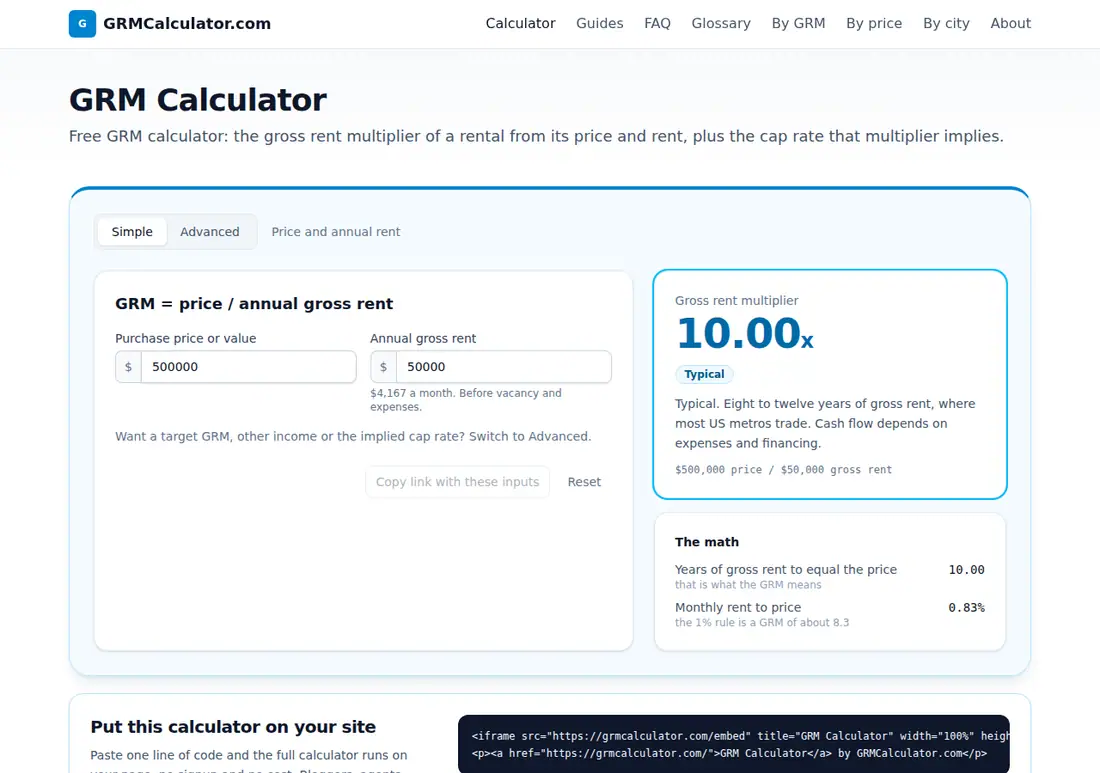
The GRM calculator on the home page takes a price and a rent figure and returns the multiplier. Enter total monthly rent across all units, or the annual total if that is what the listing gives you, and work down your list one building at a time.
Frequently asked questions
How do you calculate gross rent multiplier on a multifamily building?
Add the annual rent for every unit, including any that sit empty, then divide the price by that total. A $500,000 building renting for $4,000 a month across all units collects $48,000 a year, so the GRM is about 10.4. The math does not care whether that $4,000 comes from two units or four.
What is the average GRM in real estate?
There is no reliable single average. The multiplier depends on the metro, the submarket, the number of units and the age of the building. Expensive coastal markets routinely price small buildings in the teens, while cheaper inland markets sit much lower. The only average worth using is the one you build from recent sales of similar buildings near the one you are pricing.
Does gross rent multiplier account for vacancy?
No. GRM uses gross scheduled rent, which treats the building as full for twelve months. A duplex with one unit empty two months out of the year still shows the same GRM as an identical building that never lost a day. If you want vacancy in the number, divide price by collected rent instead and label it clearly.
Why do five-unit buildings often price differently than four-unit buildings?
One to four units qualify for residential mortgages, so those buildings attract both investors and owner-occupants and get bid up. At five units the property is commercial, financed on the building's own income and debt service coverage. That smaller buyer pool is why a five-unit can trade at a lower multiplier than a nearly identical fourplex nearby.