How to Convert GRM to Cap Rate With an Operating Expense Ratio
How to convert GRM to cap rate in one step: cap rate equals one minus the operating expense ratio, divided by GRM. Worked example, table and reverse math.
By the GRMCalculator.com team
How to convert GRM to cap rate: divide one minus the operating expense ratio by the GRM. A property with a GRM of 10 and expenses running 40 percent of rent has a cap rate of about 6 percent, because 0.60 divided by 10 is 0.060.

That single line is the whole bridge between the two numbers. Everything below is about getting the expense ratio right, since the conversion is only as good as that one input.
The arithmetic link between GRM and cap rate
GRM is purchase price divided by annual gross rent. A cap rate is net operating income divided by purchase price. Price sits in both, so it drops out when you connect them.
Net operating income is gross rent minus vacancy minus operating expenses. Write those expenses as a share of rent and NOI becomes rent multiplied by a fraction. Divide that by price and the cap rate falls out.
So the two measures are not rivals. They sit on the same line, and the operating expense ratio is the distance between them. Which one deserves your trust is a different question, covered in the note on whether GRM and cap rate measure the same thing.
The formula: cap rate = (1 - operating expense ratio) / GRM
Cap rate equals one minus the operating expense ratio, divided by the GRM. The ratio here means total operating expenses as a share of gross rent.
If your ratio is measured against collected rent instead of scheduled rent, add a vacancy term:
cap rate = (1 - vacancy rate) x (1 - expense ratio) / GRM
At 5 percent vacancy and a 40 percent expense ratio the numerator is 0.57, so a GRM of 10 converts to a 5.7 percent cap rate rather than 6.0 percent. Pick one convention and stay with it, or you will end up comparing two properties on two different sums.
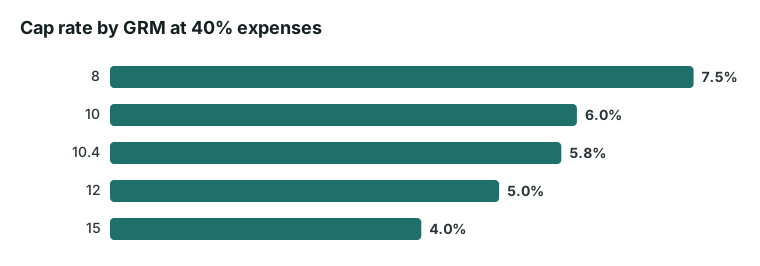
The same formula as a grid:
| GRM | 30% expenses | 40% expenses | 50% expenses |
|---|---|---|---|
| 8 | 8.8% | 7.5% | 6.3% |
| 10 | 7.0% | 6.0% | 5.0% |
| 10.4 | 6.7% | 5.8% | 4.8% |
| 12 | 5.8% | 5.0% | 4.2% |
| 15 | 4.7% | 4.0% | 3.3% |
Read across a row and the weakness of GRM shows up fast. One multiplier spans a wide band of cap rates. Each multiplier page, such as a GRM of 10, lists that band.
Finding an operating expense ratio you can trust
The conversion stands or falls on this number. Guess it and you have manufactured a cap rate rather than measured one.

Where to get a real number
Ask for the trailing twelve months of operating statements. Then rebuild the lines that change when you buy: property tax at the rate your county applies after a sale, your own insurance quote, the current HOA statement, and management at the rate in your agreement, often quoted at 8 to 10 percent of collected rent.
Add a reserve for turnover and repairs even if the seller shows none.
What belongs in the ratio and what does not
Operating expenses cover taxes, insurance, management, repairs, HOA dues, owner paid utilities and that reserve. They do not cover mortgage payments, depreciation or capital work such as a new roof. The IRS guidance on rental income and expenses draws a similar line between an ordinary repair and an improvement.
As a planning range, single family rentals where the tenant pays utilities often land in the 30s as a share of gross rent, and small multifamily with owner paid heat, water and common area power often sits in the 40s. Those are starting points, not facts about your building. Taxes alone can move the answer by a point of cap rate, because effective property tax rates differ a great deal by state and county.
Worked example: a GRM of 10 at a 40 percent expense ratio
Take the standard case. A $500,000 rental renting for $50,000 a year has a GRM of 10 on the simple tab.
At a 40 percent expense ratio, cap rate = 0.60 / 10 = 6.0 percent. The long way agrees. Expenses of $20,000 leave NOI of $30,000, and $30,000 on $500,000 is 6.0 percent.
Now use the monthly figure. $4,000 a month is $48,000 a year, which gives a GRM of about 10.4 on the same $500,000 price. Same 40 percent ratio: 0.60 / 10.4 = 5.8 percent. NOI is $28,800, and that over $500,000 is 5.76 percent.
Two thousand dollars of annual rent moved the cap rate by roughly a quarter point. That is how sensitive the conversion is to the rent you feed it, which is why proforma rent and actual rent should never be mixed inside one comparison.
Converting a cap rate back into a target GRM
Flip the formula: GRM = (1 - operating expense ratio) / cap rate.
Say a broker quotes 6.5 percent as the going cap rate for your submarket. At a 40 percent expense ratio your target GRM is 0.60 / 0.065, about 9.2. On $50,000 of rent that points to a price near $461,000. Check it: NOI of $30,000 over $461,000 is 6.5 percent.
That gives you a screening ceiling. Anything priced above a 9.2 GRM in that submarket is asking more than the local cap rate supports, unless its expenses really do run below 40 percent of rent.
Where the conversion breaks down
- Different expense structures. A condo with $400 a month in dues and a house with none can share a GRM. Their cap rates will not match.
- Other income. Laundry, parking and pet fees sit in NOI but usually not in the rent behind a GRM, so the conversion understates the cap rate a little.
- Deferred work. NOI excludes capital spending, so a building that needs a roof converts to the same cap rate as one that does not.
- Mismatched quotes. Some cap rates rest on in place rent, some on stabilized rent, and some leave management out entirely.
- Across markets. Tax and insurance gaps are big enough that a converted cap rate in one state tells you little about another.
The conversion also says nothing about your loan. A 6 percent cap rate does not survive a higher borrowing cost, which is why cash on cash return comes after the cap rate rather than before it. For the wider comparison of what each measure counts, read GRM against cap rate.
Run both numbers on the GRM Calculator
The GRM Calculator shows the implied cap rate beside the GRM on every run, and lets you set the vacancy and expense ratio yourself. Move the expense ratio and watch the cap rate shift. If your honest estimate sits far from the default, that is the signal the GRM is misleading you on that property.
Frequently asked questions
What operating expense ratio should I use when the seller will not share expenses?
Build one from the pieces you can verify. Pull the property tax rate your county applies after a sale, get a real insurance quote, read the HOA statement, and add management at your agreement rate. Then add a maintenance and turnover reserve. That bottom up figure beats any rule of thumb, and you can show your work to a lender.
Why does my converted cap rate differ from the one a broker quoted?
Usually the expense assumptions differ. Broker cap rates often rest on proforma rent, on in place taxes rather than reassessed taxes, or on a number with no management fee and no turnover reserve. Any one of those lifts net operating income and the cap rate with it. Ask which expenses sit inside the figure, then rerun the conversion with your own ratio.
Can I convert a GRM to a cap rate without knowing expenses?
No. The expense ratio is the only thing linking the two, so without it you can state a range and nothing more. A GRM of 10 is a 7 percent cap rate at 30 percent expenses and a 5 percent cap rate at 50 percent. That spread is wide enough to decide whether a property covers its loan.
Does the formula work for commercial property as well as rentals?
The arithmetic is identical, but commercial leases change the ratio. Under a triple net lease the tenant pays taxes, insurance and maintenance, so the operating expense ratio can be very low and the GRM sits close to the inverse of the cap rate. Gross leases push the ratio up. Check the lease type before you convert anything.