Income Approach Formula: How Direct Capitalization Values an Income Property
The income approach formula is net operating income divided by the capitalization rate. See each step, the capitalization factor, and a worked rental example.
By the GRMCalculator.com team
The income approach formula is net operating income divided by the capitalization rate. A building with $31,200 of net operating income, valued at a 6.5% rate, is worth $480,000. Appraisers call that single step direct capitalization.
This guide runs the arithmetic. If you want the version that skips expenses, start with how to value a rental with gross rent multiplier. If you want to know where a multiplier sits inside an appraisal report, the guide on where a multiplier fits in the income approach covers that. What follows is the full formula, line by line.
The income approach formula in one line
Value = net operating income / capitalization rate
Turn it around and the answer is the same: value = net operating income x capitalization factor, where the factor is 1 divided by the rate.
The income approach is one of three recognized valuation methods. The other two are the sales comparison approach, which reads recent sales, and the cost approach, which prices land plus construction minus depreciation. Only the income approach values a property from the money it earns. The income approach entry on Wikipedia sets out the same method and its variants.
Stated as steps, the formula for the income approach runs:
- Build one year of net operating income.
- Pick a capitalization rate from comparable sales.
- Divide the income by the rate.
Step one: build net operating income
Net operating income is what a property earns in a year after operating costs and before financing. Start at gross scheduled rent and work down.
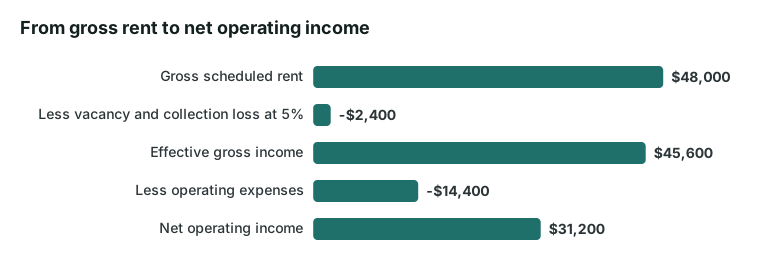
| Line | Example |
|---|---|
| Gross scheduled rent | $48,000 |
| Less vacancy and collection loss at 5% | -$2,400 |
| Effective gross income | $45,600 |
| Less operating expenses | -$14,400 |
| Net operating income | $31,200 |
Three things stay out of that table. Mortgage payments, because the value of a building does not change with how a buyer borrowed. Depreciation, because it is a tax entry rather than cash. And one time items such as a new roof, which come off the finished value instead of the operating expenses.
The example carries $14,400 of expenses on $45,600 of effective gross income, about 32%. Small rentals often land in the 30% to 45% range once taxes, insurance, management, maintenance and reserves are counted, but the only ratio worth using is the one your own bills support.
Step two: pick a capitalization rate from comparable sales
The rate is not a number you choose. It comes out of what buyers recently paid.
For each sale, divide the net operating income at the time of sale by the price. Six to ten comparable sales give a usable cluster, and the median is your market rate.
Rates move with the market and with property type. A capitalization rate tends to be lower where rents are growing and units fill quickly, and higher on older buildings, weaker locations and shorter leases. Use local sales rather than a national average, because the spread between metros is wide.
Step three: divide income by the rate
$31,200 divided by 0.065 is $480,000.
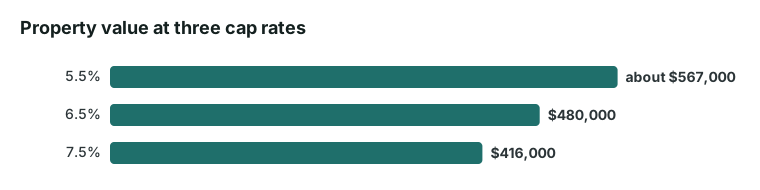
The rate does most of the work in that division. A point either way moves the answer more than people expect.
| Cap rate | Capitalization factor | Value of $31,200 of NOI |
|---|---|---|
| 5.5% | 18.2 | about $567,000 |
| 6.5% | 15.4 | $480,000 |
| 7.5% | 13.3 | $416,000 |
Same income, priced three ways. Once your expense figures are solid, the rate deserves more of your attention than the income does.
Capitalization factor: the same math as a multiplier
A capitalization factor is 1 divided by the capitalization rate. A 6.5% rate is a factor of about 15.4, so $31,200 times 15.4 lands on the same $480,000.
The factor is just a multiplier applied to net income, which is why it also goes by net income multiplier. Rates and multipliers are two ways of saying one thing, and the reciprocal link between them is exact. The guide on the multipliers past GRM walks the full ladder from gross rent down to net income.
Is the income value method the same thing?
Yes. Income value method, income capitalization approach and direct capitalization all describe valuing a property from its income.
One distinction is worth keeping. Direct capitalization uses a single year of income and one rate. Yield capitalization projects several years of cash flow and discounts them, which suits a property whose income is set to change, such as a building with below market leases rolling over soon.
Worked example on a small rental building
Take the standard example on this site. A $500,000 rental renting for $4,000 a month collects $48,000 a year, so the gross rent multiplier is about 10.4.
Now run the income approach formula on it. Vacancy and collection loss at 5% is $2,400, leaving $45,600 of effective gross income. Operating expenses of $14,400 bring net operating income to $31,200. At a 6.5% market rate, the indicated value is $480,000.
The asking price sits $20,000 above that, about 4%. Put another way, a buyer paying $500,000 accepts a cap rate of 6.2%, because $31,200 divided by $500,000 is 6.24%. Whether that is a poor deal depends on whether the comparable sales really closed at 6.5%.
Change one input and watch it move. Hold the rent and the rate, push expenses to $17,400, and net operating income falls to $28,200. The value drops to about $434,000.
When a gross rent multiplier replaces the full formula
The formula needs verified expenses. Plenty of small listings never produce them, and that is where a multiplier takes over.
With only an annual rent figure, the simple version works the same way: $500,000 on $50,000 of annual rent is a GRM of 10. No expense line is involved, which is both the appeal and the weakness.
The two methods are connected. In the example, net operating income is 65% of gross rent and the GRM is 10.4. Divide 0.65 by 10.4 and you get a cap rate of about 6.2%. A multiplier is a cap rate with the expense ratio still hidden inside it.
So use GRM to sort listings and set a first range. Save the income approach formula for the ones you are ready to make an offer on.
Run your own numbers
The GRM Calculator on the home page takes a price and a rent and returns the multiplier, plus the price a given rent supports. When a seller finally hands over an expense statement, build net operating income from it, divide by the market rate, and see whether the two valuations agree.
Frequently asked questions
What is the formula for the income approach?
Value equals net operating income divided by the capitalization rate. Build one year of net operating income by taking gross scheduled rent, subtracting vacancy and collection loss, then subtracting operating expenses. Pull the rate from comparable sales in the same submarket, then divide. A property with $31,200 of net operating income at a 6.5% rate values at $480,000.
What is a capitalization factor?
The capitalization factor is one divided by the capitalization rate, so a 6.5% rate is a factor of about 15.4. Multiply net operating income by the factor and you get the same value that dividing by the rate gives. Appraisers also call it the net income multiplier, because it shows how many years of net income the price represents.
What is the income value method?
The income value method is another name for the income approach: value a property from the income it produces rather than from what similar buildings sold for. Direct capitalization is the one year version, dividing net operating income by a market rate. Yield capitalization discounts several years of projected cash flow instead, which suits properties with changing income.
How is the income approach formula different from a gross rent multiplier?
The income approach formula works on net operating income, so it accounts for vacancy and operating expenses. A gross rent multiplier works on gross rent and ignores both. GRM is faster and needs only a price and a rent figure, which is why it fits small rentals where expense records are thin. Direct capitalization is more accurate when the expenses can be verified.