Comparable Rent Schedule: How an Appraisal Documents Market Rent
The comparable rent schedule is the form that sets market rent on your appraisal. What each line means, how comps get adjusted, and what to do if it is low.
By the GRMCalculator.com team
A comparable rent schedule is the appraisal form that documents market rent for a rental property, built from recent leases on similar homes nearby. Lenders order one when a loan depends on rental income, and the market rent the appraiser concludes is the number underwriting uses, even when your lease collects something else.

It is usually one page, filed behind an appraisal most investors never read past the value on the front. This guide walks the form line by line: what it claims, how the comps get adjusted, and what to do when the rent on it is wrong.
When a lender orders a rent schedule
For a single unit rental, the schedule is a separate attachment to the main appraisal report. Fannie Mae publishes it as the Single-Family Comparable Rent Schedule, Form 1007. On two to four unit property the same work happens inside the appraisal report itself, on the small residential income property form, and an operating income statement may come with it.
Three situations usually trigger the order:
- You are buying a rental and want the lender to count rent toward qualifying income.
- You are refinancing a property you already rent out, including a cash-out refinance.
- You are moving out of a primary residence and want its new rent to offset the old payment.
The person filling it out is the licensed appraiser who values the property, working under the same rules that govern any real estate appraisal. Those rules come from the Uniform Standards of Professional Appraisal Practice, which is why the form asks for data sources rather than impressions.
What sits on the form
| Section | What it holds |
|---|---|
| Subject | Address, unit count, bedrooms and baths, living area, the rent your lease collects, lease dates |
| Rent comparables | Three recent rentals with address, distance, size, amenities, monthly rent and data source |
| Adjustments | Dollar amounts added to or taken off each comp rent for differences |
| Reconciliation | The appraiser’s market rent conclusion for the subject, usually one monthly figure |
The data source line matters more than it looks. Rent comps taken from closed leases carry more weight than asking rents on active listings, because an asking rent is a hope and a signed lease is a fact.
How the appraiser picks and adjusts the rent comps
Rent comps are not sale comps. Comparables on a rent schedule have to be rentals, leased recently, drawing on the same renter pool as the subject. A sale three doors down tells you nothing about rent.
The usual screen runs in this order:
- Location, ideally the same neighborhood and school attendance area.
- Bedroom and bath count, since renters shop by bedrooms first.
- Living area and layout.
- Age, condition and recent updates.
- Amenities such as a garage, central air, in unit laundry or a yard.
- Which utilities the rent includes, and whether the unit is furnished.
- The date the lease was signed, with newer leases preferred.
Each difference becomes a dollar per month adjustment. A comp with a garage the subject lacks gets adjusted down. A comp with one fewer bedroom gets adjusted up. The adjusted rents should cluster, and the conclusion should land inside that cluster.
A worked example
Take the standard example on this site. A $500,000 rental renting for $4,000 a month collects $48,000 a year, so the gross rent multiplier is about 10.4.
Say the schedule shows three comps at $3,800, $4,200 and $3,950 a month before adjustments. The $4,200 comp has a finished basement, so it gets marked down. The $3,800 comp comes with no appliances, so it gets marked up. The adjusted figures tighten, and the appraiser concludes market rent of $3,900.
That conclusion moves the multiple. At $3,900 a month the property collects $46,800 a year, and $500,000 divided by $46,800 is a GRM of about 10.7 instead of 10.4. Nothing about the building changed. Only the rent figure did.
Market rent is not the rent your lease collects
The form carries both numbers for a reason. Contract rent is what your tenant pays. Market rent is what the unit would lease for today, at arm’s length, with both sides informed and neither one under pressure.
The two drift apart constantly. A tenant three years into a lease is often paying under market. A unit under rent control can be far under. A furnished short stay rental can run far over, which is why appraisers rarely treat nightly income as market rent for a long term loan. Federal programs use a related idea for their own purposes: HUD publishes Fair Market Rents by area each year.
So read the schedule as a statement about the unit, not about your lease. That gap is one reason pro forma rent and actual rent produce different multiples on the same property.
What to do when the schedule disagrees with your numbers
Start with the comps, not the conclusion. Most low rent conclusions trace to one weak comp: a smaller unit, a dated one, an older lease, or one across a boundary where rents run lower.
Then send the lender a short factual package. Signed leases for the subject. Two or three closed rental comps with addresses, lease dates, bedroom counts and rents. A note on anything the appraiser could not see, such as a finished renovation or paid parking that comes with the unit.
Ask for a reconsideration of the rent conclusion, not a favor. Appraisers can and do revise when handed better data, and they cannot revise because a borrower wants a larger loan. Keep the whole request about the comps.
How lenders use the rent figure
Most residential programs do not count the full rent. A common approach counts 75% of gross rent as qualifying income and holds the rest back for vacancy and upkeep, though the exact treatment depends on the loan program and the documents you provide.
Many programs also use the lower of market rent and your actual lease rent. A schedule that comes in under your lease can therefore shrink the income the file is allowed to use. On investor loans sized by debt service coverage ratio, that same rent figure drives the ratio and with it how much you can borrow.
What rent a given price buys varies a lot by market, so check a conclusion against local patterns before you argue with it. The metro pages show how far those typical multiples spread.
Check the multiple before you sign
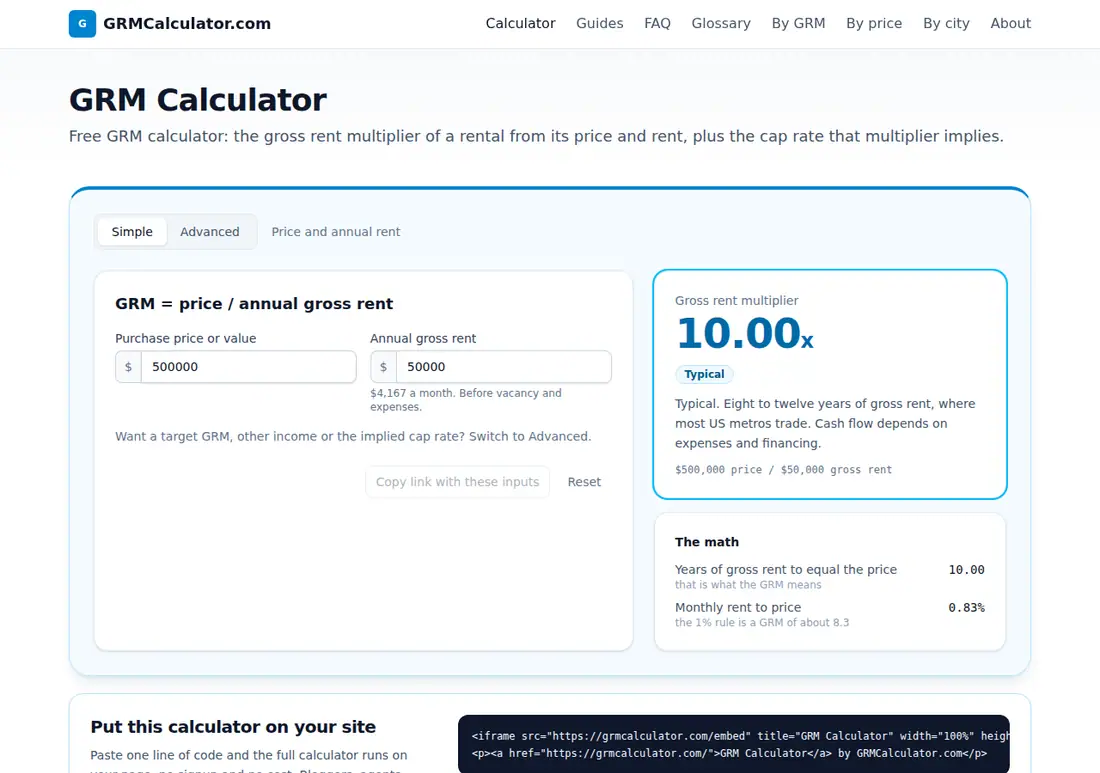
Once you know the rent figure the lender will use, put it against the price and look at the multiple. The GRM calculator on the home page takes a price and a monthly or annual rent and returns the multiple, so you can hold the appraiser’s market rent next to your own lease and see the difference. The simple tab works the same way: $500,000 on $50,000 of annual rent is a GRM of 10.

Frequently asked questions
What is a comparable rent schedule?
It is the appraisal form that documents market rent for a rental property. The appraiser lists the subject unit, three recent rent comparables, dollar adjustments for the differences between them, and a single market rent conclusion. Lenders order it when a loan depends on rental income, and the conclusion on that form is the rent underwriting works from.
What is Fannie Mae Form 1007?
Form 1007 is the Single-Family Comparable Rent Schedule, the form appraisers use to report market rent on a one unit rental. It is filed as an attachment to the main appraisal report. For two to four unit properties, the rent comparables and the market rent conclusion appear inside the small residential income property appraisal report instead.
How does an appraiser determine market rent?
By comparing recent leases, not sales. The appraiser pulls rentals that are close by and similar in bedroom count, size, age, condition and amenities, then adjusts each comp rent up or down in dollars per month for the differences. The adjusted rents should cluster, and the market rent conclusion sits inside that cluster. Closed leases outrank asking rents.
Does the rent schedule use my actual lease rent?
Both numbers appear on the form, but they are not the same thing. Contract rent is what your tenant pays today. Market rent is what the unit would lease for now in an arm's length deal. Leases signed years ago, rent controlled units and discounts to friends all sit below market, and the appraiser is asked to report the market figure.
What if the appraisal rent schedule comes in below my rent?
Read the comparables before you read the conclusion. A low number usually traces to one weak comp. Send the lender signed leases for the subject plus two or three closed rental comps with addresses, lease dates, bedroom counts and rents, then ask for a reconsideration of the rent conclusion. Appraisers revise for better data, not for a bigger loan.